
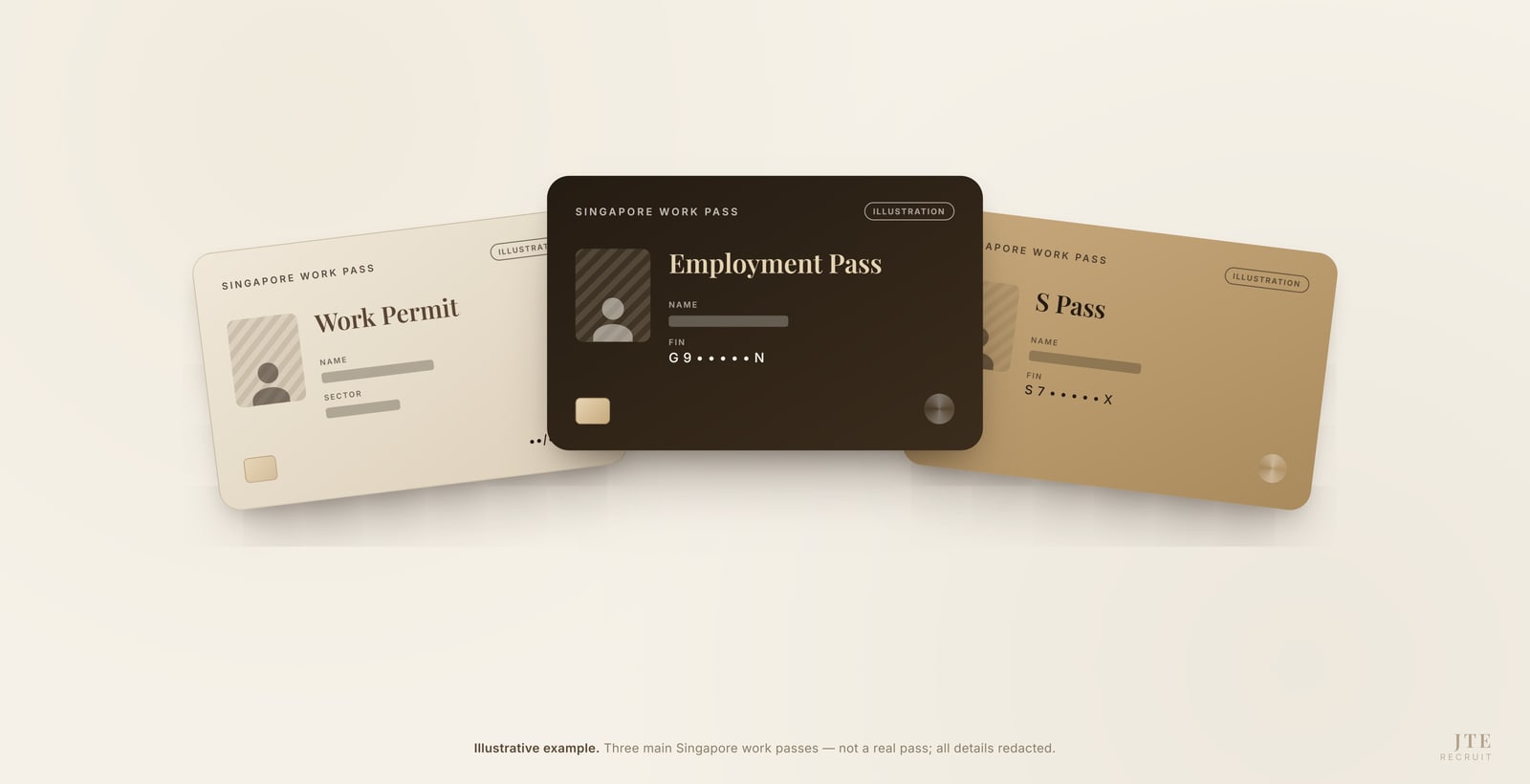
If you’re hiring someone who isn’t a Singapore citizen or PR, the first thing to sort out is the right work pass. Get it wrong and the hire stalls before day one. Here’s a plain-English guide to the three main passes employers deal with — who each is for, and what to watch for.
One thing up front: the Ministry of Manpower (MOM) updates qualifying salaries, quotas and levies from time to time. Treat this as a map of how the system works, and always check mom.gov.sg for the current figures before you budget or commit.
Employment Pass (EP)
For foreign professionals, managers and executives in higher-skilled roles. Candidates must earn at least a qualifying monthly salary — which rises with age and is set higher for the financial services sector — and, since 2023, pass the points-based COMPASS framework. COMPASS scores factors like salary, qualifications, and how the hire adds to your team’s diversity and local workforce. The upside for employers: there’s no quota and no levy on Employment Passes.
S Pass
For mid-skilled staff such as technicians and associate professionals. It has its own, lower qualifying salary than the EP, and — unlike the EP — it comes with two extra constraints: a quota (a cap on the share of your workforce that can be S Pass holders) and a monthly levy for each holder. Both the quota and the levy vary by sector.
Work Permit
For semi-skilled workers in specific sectors — construction, manufacturing, marine shipyard, process and services. Work Permits are tied to approved source countries, capped by a quota (the Dependency Ratio Ceiling, or DRC) and carry a monthly levy. They also come with a maximum period of employment. This is the pass most often used for higher-volume, hands-on hiring.
The three passes at a glance
| Employment Pass | S Pass | Work Permit | |
|---|---|---|---|
| Who it's for | Professionals & managers | Mid-skilled staff | Semi-skilled workers |
| Quota | None | Yes (varies by sector) | Yes (Dependency Ratio Ceiling) |
| Monthly levy | None | Yes | Yes |
| Salary & rules set by | MOM (COMPASS applies) | MOM | MOM |
Quotas, levies and qualifying salaries change — check mom.gov.sg for current figures.
Quotas and levies, briefly
Two ideas trip up first-time employers. A quota limits how many S Pass and Work Permit holders you can have relative to your local staff — so hiring foreign workers on these passes often depends on your existing headcount mix. A levy is a monthly fee you pay the government for each of those holders. Employment Passes have neither, which is part of why they’re reserved for higher-skilled, better-paid roles.
Which pass does my hire need?
As a rough guide:
- Professional, managerial or executive role → Employment Pass
- Mid-skilled technical role → S Pass
- Semi-skilled role in an eligible sector → Work Permit
In practice the right answer depends on the role, the salary you’re offering, and your current workforce mix — which is exactly where a quick conversation saves a lot of wasted paperwork.
How JTE helps
Getting the pass right — and keeping it compliant month to month — is fiddly. Alongside placing the right person, we can manage the work-pass application and ongoing payroll, so onboarding an overseas hire stays simple and fully above board. If you’re weighing up a foreign hire, we’re happy to talk it through.