
What will this cost me? It is the first question every employer asks, and a surprisingly hard one to get a straight answer to, so here it is. Most permanent hiring in Singapore is charged as a percentage of the hire’s first-year salary, commonly around 15% to 25% depending on seniority and how hard the role is to fill. On a contingency basis you pay only if you actually hire. Contract and temporary staffing is priced differently: an ongoing rate that bundles the worker’s salary, CPF and statutory costs, plus the agency’s margin.
Below is how that pricing actually works, the typical ranges, and what to check before you sign anything.
The two ways agencies charge
Almost every recruitment fee falls into one of two models.
Contingency (success-fee)
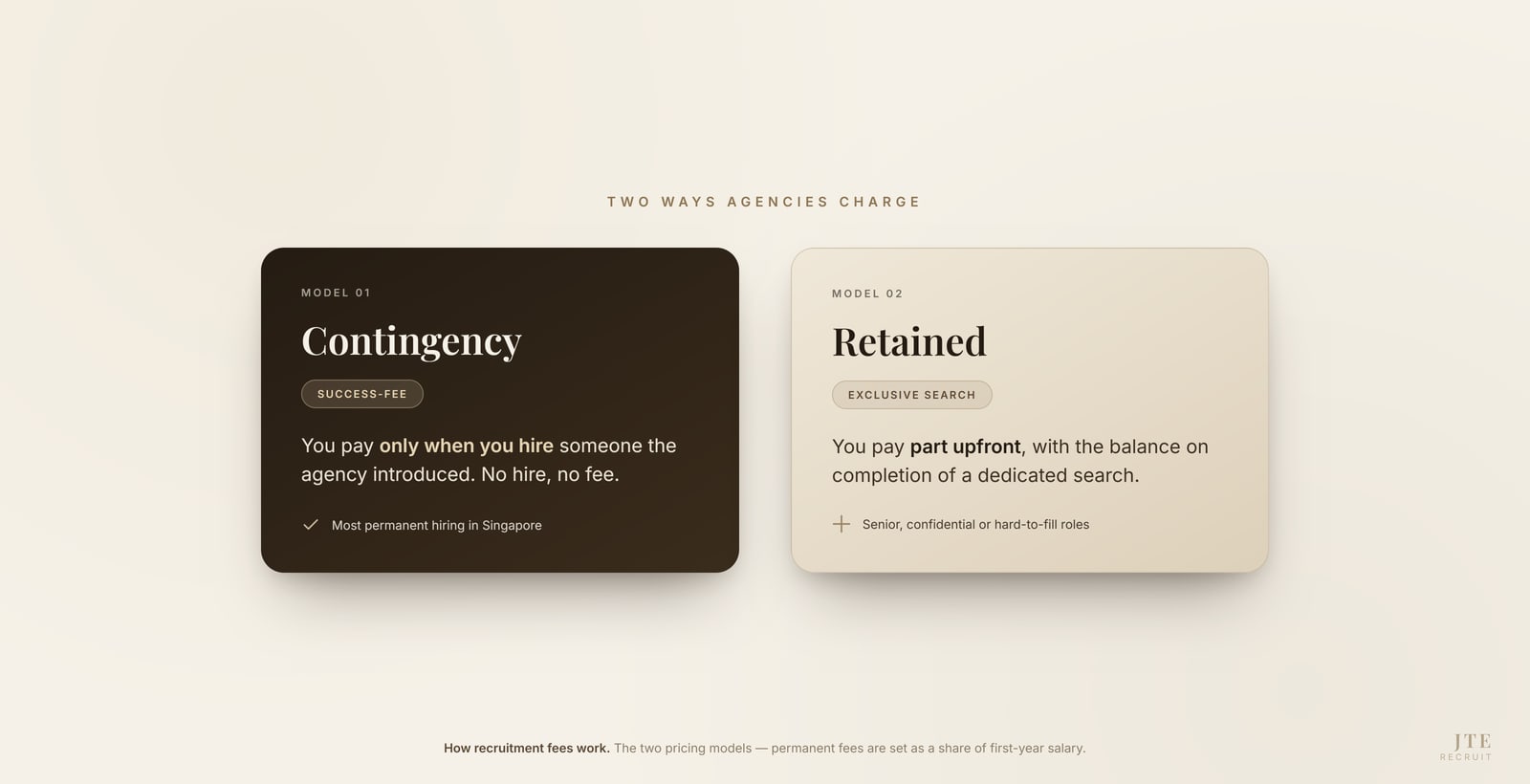
You pay only if you hire someone the agency introduced. No hire, no fee. Most permanent hiring in Singapore works this way, it puts the risk on the agency, not on you. It’s also how JTE works.
Retained search
You commission a dedicated search and pay part of the fee upfront, with the balance on completion. It’s usually reserved for senior, confidential or genuinely hard-to-fill roles where you want exclusive, in-depth work.
What a permanent placement typically costs
Permanent fees are almost always a percentage of the hire’s first-year salary rather than a flat rate. In Singapore, contingency fees commonly sit somewhere around 15% to 25% of annual salary, depending on the role, so it helps to know the going rate before you start (our Singapore salary guide has current ranges by role and seniority, and for engineering roles our breakdown of what a good engineer actually costs covers the full picture). Think of the fee as a guide, not a fixed price, a few things move it:
- Seniority and scarcity. Specialist and leadership roles take more work to fill, so they sit at the higher end.
- Volume. Hiring several people at once often earns a lower rate per role.
- How the fee is calculated. Confirm whether the percentage is on base salary or total package, it changes the number.
- Guarantee length. A longer replacement guarantee can be reflected in the fee.
Rule of thumb: the harder a role is to fill, the higher the percentage, because the work, and the risk the agency carries, is greater.
How contract & temporary staffing is priced
Contract and temp hiring work differently. Instead of a one-off percentage, you pay an ongoing rate that bundles the worker’s salary, statutory contributions (CPF, SDL) and the agency’s margin. You’ll usually see one of two structures: a markup on the hourly or daily rate, or a fixed monthly fee per head where you fund the salary and the agency handles employment and admin.
If you’d rather keep people on your own payroll and only outsource the paperwork, some agencies, JTE included, can handle just the administration for a per-headcount fee, one tidy invoice instead of a payroll headache, which we explain in contract staffing on one invoice. You can see how that works on our payroll & work pass page.
What the fee should include
A recruitment fee should buy more than a stack of CVs. Expect role scoping, sourcing and screening, a considered shortlist, interview coordination, offer management, and, importantly, a replacement guarantee: if the hire leaves within an agreed period, the agency finds a replacement. If a quote looks cheap, check what’s missing from that list.
Questions to ask before you sign
- Is this contingency or retained?
- What’s the exact percentage, and is it on base salary or total package?
- What does the replacement guarantee cover, and for how long?
- Are there any upfront or admin fees?
- Do you ever charge the candidate? (The answer should be no.)
How JTE approaches it
We work on a success-fee basis: you only pay when you actually hire, and we agree the terms clearly with you before any search begins, no upfront cost, no surprises. Job seekers are never charged a cent. If you’d like a straight quote for a specific role, tell us what you’re hiring for and we’ll walk you through it.